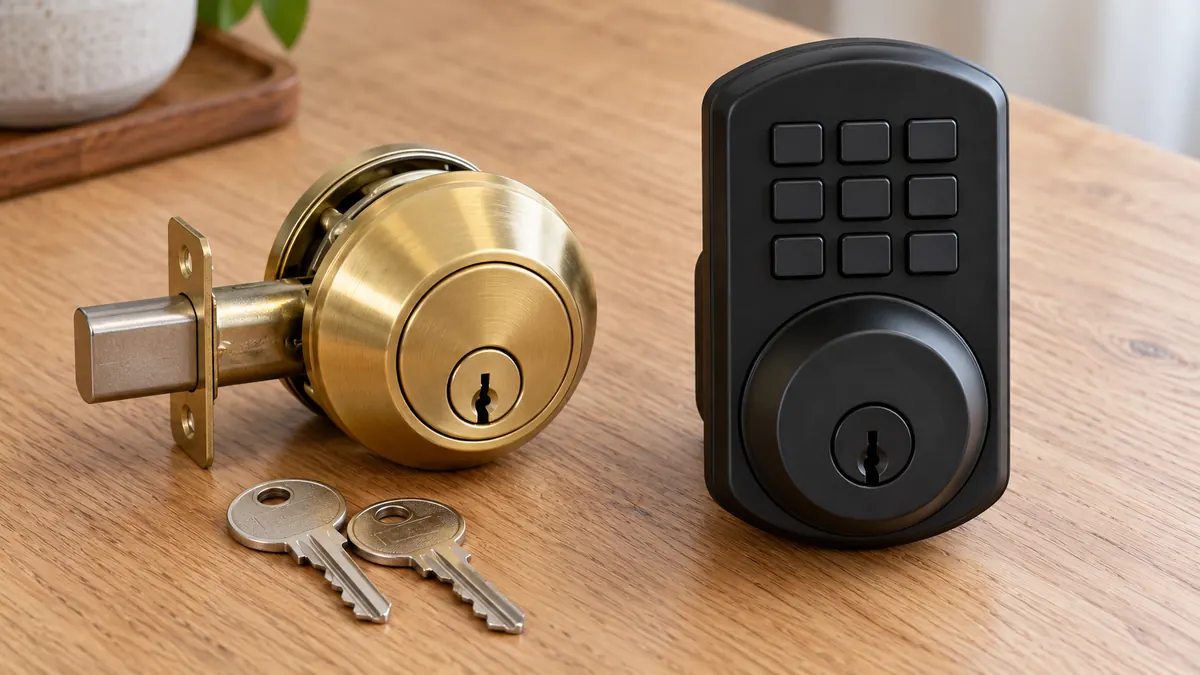
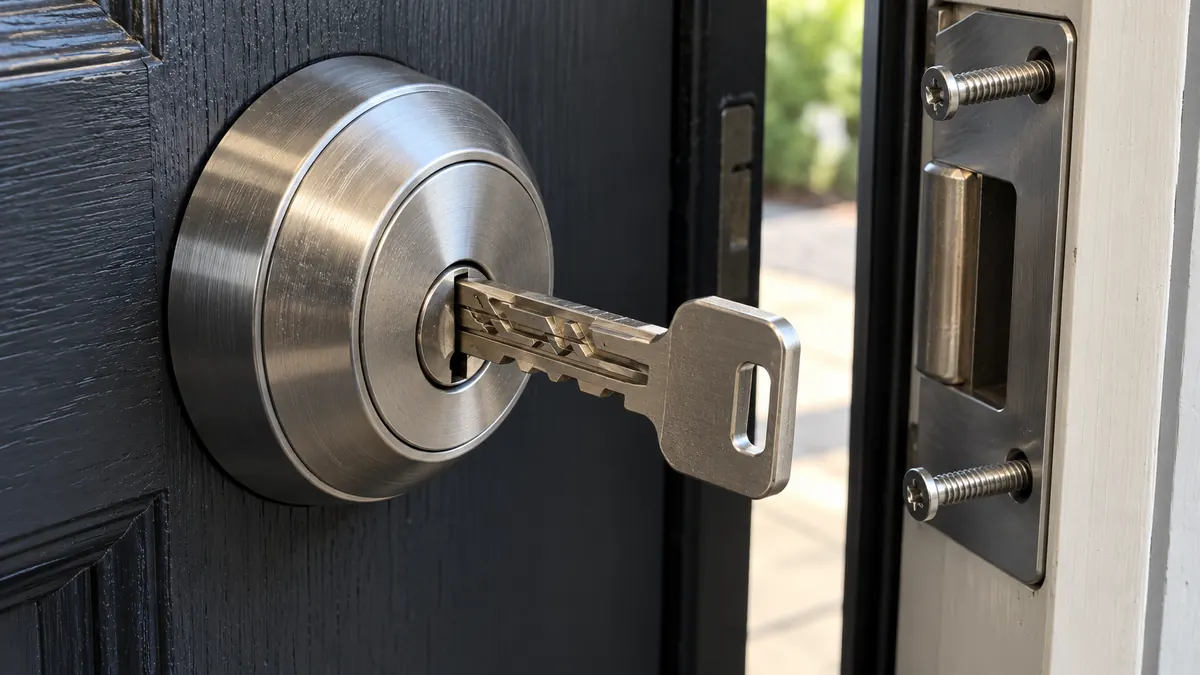
A high-security door lock is a cylinder built to resist picking, bumping and drilling, paired with a patented or restricted keyway so copies of the key can only be cut through an authorized dealer. For most homes that means a Grade 1 deadbolt with a high-security cylinder from a maker like Medeco or Mul-T-Lock, installed with a reinforced strike plate and 3-inch screws.
The part most homeowners are really paying for is key control: a key that no kiosk or hardware counter can copy. That is worth the money after a break-in or in a rental with tenant turnover. It also makes sense in a house where nobody can say anymore how many keys are out there. Plenty of homes don't need it, though. Rekeying the locks you already have fixes the real problem for far less. Apex Locksmith Pros does both, high-security installs and standard rekeys, across McKinney and nearby cities. Here is how to tell which one your door needs.
Need it handled today? Lock Installation from a licensed mobile locksmith in McKinney and nearby cities.
In this guide (7 sections)
What makes a door lock high-security?
Three things separate a high-security lock from the deadbolt in a blister pack at the hardware store.
Start with the keyway. High-security cylinders use a patented or restricted key profile, and the manufacturer decides who can buy the blanks. Medeco and Mul-T-Lock both sell through authorized dealers, never through kiosks. Many systems also come with a key control card, and nobody cuts a copy unless the card or the registered owner's signature is presented.
Then there are the pins. A standard cylinder has a single row of spring-loaded pins. High-security cylinders add extra locking parts: Medeco pins have to lift and also rotate to the right angle, and Mul-T-Lock puts telescoping pins inside pins. All that extra work is why picking and bumping get so much harder.
Last comes the hardening. Hardened steel inserts and anti-drill pins guard the shear line, so drilling through the cylinder takes much longer and makes a lot of noise. Slow and loud is the point.
What the label does not replace is the BHMA grade. The grade, 1 to 3, rates how strong and durable the deadbolt is. The high-security features rate the cylinder and the key. A good install needs both.
Which keys cannot be duplicated?
Only keys on a restricted or patented keyway are truly safe from being copied off the street. The patent covers the key profile itself, so kiosks and most hardware counters never stock the blanks. Copies come from an authorized dealer, who checks the key control card or the registered name before cutting anything.
A key stamped "Do Not Duplicate" is another matter. On a standard Kwikset or Schlage blank, that stamp is a polite request to whoever runs the machine. It is generally not a legal block, and some shops cut it anyway. If a landlord or a previous owner counted on that stamp for key control, assume copies may exist.
Car keys are their own category. Anyone with the right machine can often cut a transponder chip key or a push-to-start smart key, but the car won't start until the new key is programmed to the immobilizer. That is why a spare car key made from a working one starts at $119+, and programming a fob you already own starts at $129+. Cutting is the easy part. Programming is what keeps a random copy from starting your truck.
Pick, bump and drill resistance in plain terms
High-security cylinders are tested against three kinds of attack, so it helps to know what each one looks like.
Picking means working the pins one at a time with thin tools until the plug turns. It takes skill and patience. The extra elements in a high-security cylinder add enough steps that most people can't make it work.
Bumping is cruder. Someone taps a specially cut key with a small mallet and jolts every pin at once. A basic pin tumbler deadbolt is open to it, and bump keys are easy to find online. Sidebars, rotating pins and telescoping pins beat the trick because one sharp tap can't put them all in the right place. Some mainstream cylinders sold as bump resistant handle this too, without a restricted keyway, and that is a reasonable middle step.
Drilling destroys the shear line with a power drill. What slows it down is hardened steel pins and plates behind the cylinder face.
Many high-security cylinders carry a UL 437 listing, a third-party test for resistance to picking, drilling and forcing. If a product calls itself high-security and can't point to a standard like that, we'd treat the label as marketing.
A strong cylinder still needs a strong strike plate
Most forced entries go through the frame rather than the cylinder. Someone kicks near the lock, the jamb splits around the strike plate, and the door swings open with the deadbolt still out. A Medeco cylinder won't stop that by itself.
The fix is cheap next to the price of the lock:
- Swap the short strike plate screws for 3-inch screws that reach the wall stud behind the jamb.
- Put in a reinforced or box strike plate, which spreads the force of a kick across more of the frame.
- Check that the deadbolt throws its full one inch and doesn't drag on the strike.
- Run a 3-inch screw through at least one hole on each hinge, so the hinge side holds as well as the lock side.
If the door has sagged and the bolt no longer lines up with the strike, we correct that before the new lock goes in. Skip it and the bolt binds, the owner gets tired of fighting it, and the best lock in the house sits unlocked.
Weighing high-security cylinders against a rekey? Call and get a flat quote for your doors.
Who actually needs high-security locks?
Most homes in McKinney are fine with a quality Grade 1 or Grade 2 deadbolt and a recent rekey. A restricted keyway earns its cost in a handful of situations.
The obvious one is after a break-in, especially if the lock was bumped or picked instead of kicked. People want that route closed for good. Rentals are another strong case, whether it's a house or a garage apartment with tenants coming and going. On a restricted keyway, a tenant who moves out couldn't have made copies without going through the dealer.
Home offices count too. If you keep client files, inventory or equipment at a house in Stonebridge Ranch or Craig Ranch, a lock whose keys you can account for one by one deserves a serious look. And then there are big households. Teenagers, a nanny, a dog walker, a cleaner, grandparents with a spare. Keys multiply quietly, and a key control card puts the owner back in charge of the count.
If none of that sounds like your house, start with a rekey and a stronger strike plate. For a typical home in Allen, Prosper or Frisco that covers the realistic risks, and the main entry can always be upgraded later.
When standard rekeying is enough
Rekeying changes the pins inside your existing cylinder so the old keys stop working and a new key takes over. Nothing on the door gets replaced. For a new homeowner, a roommate who moved out or a lost key ring, that handles the actual problem, which is unknown keys floating around.
How the options stack up in practice:
Rekeying: same hardware, new key, every old key dead. From $35+ per cylinder. The new key can still be copied at a hardware store. High-security upgrade: new cylinder or deadbolt on a restricted keyway, with key control. Quoted on the call. Copies only through an authorized dealer. Strike reinforcement: 3-inch screws and a box strike. It helps with either option and costs far less than new hardware.
It comes down to one question. Do you need to control future copies, or just cancel the old ones? Canceling old keys is a rekey. Controlling future copies takes a restricted keyway.
How a high-security lock quote works
There is no published starting price for high-security locks, because the total depends on what goes on the door. Retrofitting one restricted cylinder into an existing Grade 1 deadbolt is a very different job from a new deadbolt and handleset on three entry doors, all keyed alike to one restricted key.
Before you call, it helps to know:
- How many exterior doors you want covered, and whether each has a deadbolt, a keyed knob or lever, or both.
- The brand on the doors now, if you know it.
- Whether you want one key for every door.
- Any door that sticks, sags or has a damaged frame.
We count the doors and cylinders with you and give a flat total on the phone before anyone is dispatched. There is no call-out fee. Apex Locksmith Pros is licensed by the Texas DPS Private Security Bureau, license #B31197901, and insured. The tech asks for ID and proof of residency before touching any lock, and the work is tested before the tech leaves.
Weighing high-security cylinders against a rekey? Call and get a flat quote for your doors.
Key takeaways
- A high-security lock pairs a restricted or patented keyway with pins that resist picking, bumping and drilling, and it limits who can order copies.
- Only keys on a restricted keyway, such as Medeco or Mul-T-Lock systems, are really protected from copying, since the blanks are sold only through authorized dealers.
- A "Do Not Duplicate" stamp on a standard key is a request to the person cutting it rather than a legal block, so copies may still be out there.
- Most kick-ins split the frame, so any lock upgrade should come with a reinforced strike plate and 3-inch screws driven into the wall stud.
- If all you need is for the old keys to stop working, rekeying the existing locks from $35+ per cylinder is usually the faster and cheaper fix.